Tour Plan
1
Day 01 - Arrival at Tribhuwan International Airport, Kathmandu
You will be welcomed by our staff and transferred to your hotel. Our airport representative will explain the program later in the hotel.
Overnight at hotel
2
Day 02 - Kathmandu Valley Sight Seeing Tour
Kathmandu valley Sightseeing tour will start early in the morning. The holy Pashupatinath temple will be our very first visit. Dedicated to Lord Shiva, Pashupatinath is one of the four most important religious sites in Asia for devotees of Shiva. Built in the 5th century and later renovated by Malla kings, the site itself is said to have existed from the beginning of the millennium when a Shiva lingam was discovered here. It lies on the banks of the Bagmati River and is one of the most revered holy sites of the Hindu people. The Pashupatinath is built in the pagoda style architecture and contains many smaller shrines outside the main temple as well. It is also the cremation site of many hindu people and sometimes, it can be observed.
The nest site of the tour is the holy Bouddhanath stupa. The Buddhist stupa of Boudha Stupa dominates the skyline; it is one of the largest unique structure's stupas in the world.The influx of large populations of refugees from Tibet has seen the construction of over 50 Gompas (Tibetan convent) around Bouddhanath. The Stupa is on the ancient trade route from Tibet which enters the Kathmandu Valley by the village of Sankhu in the northeast corner. Tibetan merchants have rested and offered prayers here for many centuries. When refugees entered Nepal from Tibet in the 1950s, many decided to live around Boudhanath. The Stupa is said to entomb the remains of Kassapa Buddha.
The next site, in the tour, is the Kathmandu Durbar Square. It is known as the Hanuman Dhoka Durbar Square, a name derived from a statue of Hanuman, the monkey devotee of Lord Ram, at the entrance of the royal palace. The Durbar at the Durbar square was the royal Nepalese residence until the 19th century and was where important ceremonies, such as the coronation of the Nepalese monarch, took place. The palace is decorated with elaborately-carved wooden windows and panels and houses the King Tribhuwan Memorial Museum and the Mahendra Museum are located here. Time and again the temples and the palaces in the square have gone through reconstruction after being damaged by natural causes or neglect. Presently there are less than ten quadrangles in the square. On 25 April 2015, an earthquake with an estimated magnitude of 7.9 hit the region and severely damaged the Square, reducing several buildings to rubble. The oldest temples in the square are those built by King MahendraMalla (1560–1574). They are the temples of Jaggannath, KotilingeswaraMahadev, Mahendreswara and the Taleju Temple. More and more temples and statues were added to the Square under different ruling kings over the time. It is one of the most architecturally intricate showcases of Nepali art and the unique Newa architecture.
Then finally, the last site of the tour will be the Swayambhunath Stupa- an ancient religious architecture at the top of a hill in the Kathmandu Valley, west of Kathmandu city. Swayambhunath is probably the most sacred among Buddhist pilgrimage sites especially for Tibetans and followers of the Tibetan Buddhism. We were breathless and sweating as we stumbled up the last steep steps and practically fell upon the biggest vajra (thunderbolt scepter) that I have ever seen. Behind this Vajra was the vast, round, white dome of the stupa, like a full solid skirt, at the top of which were two giant Buddha eyes wisely looking out over the peaceful valley which was just beginning to come alive. The complex consists of a stupa, a variety of shrines and temples, some dating back to the Licchavi period.
After visiting each site, we will head back to the Hotel.
Overnights stay at the Hotel in Kathmandu. Breakfast included.
3
Day 03 - Kathmandu to Pokhara (910m/2985ft), Duration: 6 hours
We’ll drive from Kathmandu, the city of temples to Pokhara, the city of lakes. It takes about 6-7 hours we pass by beautiful landscape of terrace farming, fields of barley, rice and rivers along the way. When we arrive the city of lakes i.e. Pokhara, we will drive you to your hotel where you take rest and stay. In the evening, you shall be able to enjoy the respite of a beautiful boat-ride at Fewa Lake and on a clear day, you can see the lucid reflection of Mount Machhapuchhre and the Annapurna Range on the crystalline surface of water as well. Overnight Hotel, breakfast in included.
Overnight stay at the Hotel, Breakfast included.
4
Day 04 - Pokhara to Kagbeni, Duration: 8 hours
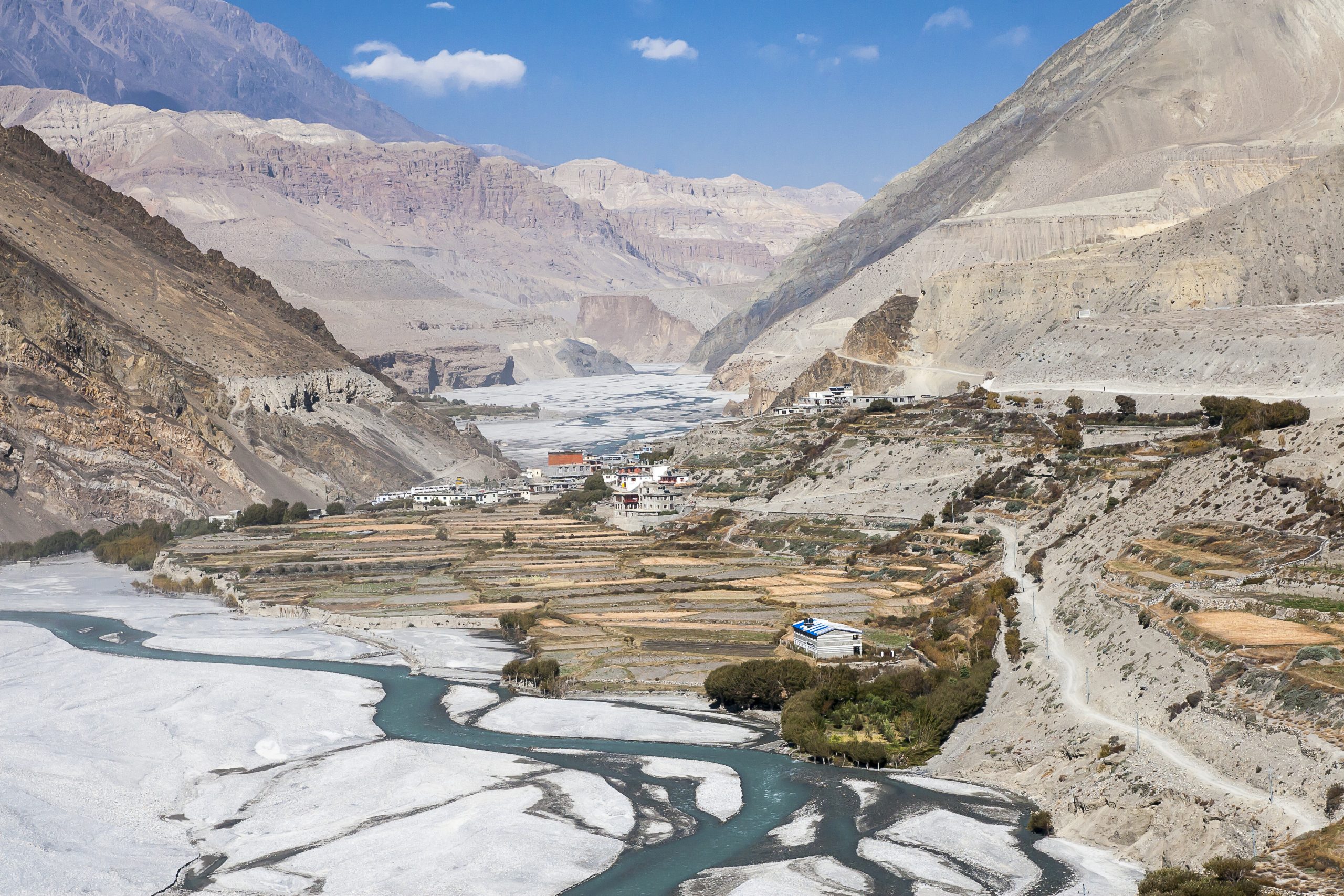
After a well sleep in Pokhara, a beautiful drive to Kagbeni commences in the morning. The journey is filled with amazing landscapes. Kagbeni is ideally located at the bank of two rivers in the Valley of Kali Gandaki River and the village is beautiful with flat roofed houses. It also has ruins of an old fortress. It is usually the entry point to Mustang. That is why Kagbeni is also called the main gate to Upper Mustang. There is a check point at Kagbeni that controls groups departing for Muktinath and Mustang. Trekkers are required to show their permits here for further entry. As you drive further into Kagbeni, you will notice the difference in the change of the landscape from lush green winding hills to hills that become consistently barren and ashy white being the rain shadow of the mount Dhaulagiri and Annapurna. The Tibetan culture and its features also become quite prominent at Kagbeni, and it feels more and more like Tibet itself that is why Upper Mustang is also called as mini Tibet. The village of Kagbeni is designed as a fortress town, and was quite important hub for famous salt trade between Tibet and Nepal. Upon arriving at Kagbeni, you can wander around the village’s cobbled streets laden with prayer wheels on the walls of the chortens and small Gompas. At Kagbeni, you can also visit “the Red Monastery” that has red washed walls and is a giant block of a building built around 1429. The village’s solidarity is felt on the dry watered-grey color of its environment and the highly oxidized hills.
Overnight stay at the guesthouse at Kagbeni, breakfast, lunch and dinner included.
5
Day 05 - Kagbeni to Charang (Tsarang), (3500m/11482ft)
Driving ups and downs on white hills and a terrain we will reach at Charang (Tsarang). Tsarang lies to the south of Lo Manthang- the capital of Mustang. Tsarang has many chortens, Buddhist temple (gompa) and the old fort (dzong). Some buildings are renovated, but others almost ruined. The surrounding landscape full of cliffs and rocks offers breathtaking scenery. Upon your arrival, you will also like to visit the monastery at the village. The monastery’s inner walls are painted with murals depicting the deities of the Medicine Buddha Mandala. These depictions and rituals of the Medicine Buddha are special objects of devotion in the Kingdom of Mustang and can be found in the temples of almost every Mustang village.
Overnight stay at the guesthouse, breakfast, lunch and dinner included.
6
Day 06 - Charang – Hike to the Luri Cave – return
You will have a hike to the Luri Cave today. Luri is an ancient cave monastery filled with artifacts, Buddhist frescos, and chortens – some dating back from the 14th century. Luri is well worth a visit: set high in the cliffs, visitors must scramble up a dirt trail, and then climb up a wooden ladder to access the lower caves.
The Luri Gompa lies south-east to Lo Manthang and is considered an ancient cave system that has very little known about its establishment. The Luri Gompa is pitted with sandstone cliffs and bluffs fluted by wind and weather into fantastical formations, like serried, tapered pillars or organ pipes. These cliffs are pitted with caves, and such a cave forms the inner sanctum of the Luri Gompa, a small jewel of Buddhist art. The Luri Gompa is a Cave Monastery that sits high above the crumbling landscape like an eagle’s nest. It is also sometimes referred to “the Sky Cave”. One of the last cave monasteries in Lo Manthang and Tibet, the Luri Gompa has no written records that exist regarding its construction. Covered with a red wash, perched on a ledge on a one hundred-meter high cliff, the Gompa stands out against the sand and bone-colored sandstone pillars. Affiliated with the Kagyu sect of Buddhism, the Gompa dates all the back to the 13th-14th century. A part of the Luri Gompa is visible from the valley below; its mud-brick superstructure perched on a ledge on one of the sandstone pillars. At first, it seems like the entrance to the cave is obtained only by scaling the pillar itself, but a winding footpath climbs one hundred meters to a door in a lower cave, inside which is a notched log that climbs to the Gompa itself. The treasures of the Gompa lie in its inner chambers that are hollowed-out or enlarged rooms with smooth walls. Natural light trickles in through a small window, making the space look ethereal. After exploring the cave, you will return back to Tsarang.
Overnight at guesthouse, breakfast, lunch and dinner included.
7
Day 07 - Charang to Lo Manthang - 3600m/13 km
From Tsarang, we drive to the capital of the Mustang Kingdom- Lo Manthang. The drive goes ups and downs of beautifully unique terrain and corroded hills. After a short rest, we explore the village Lo-Manthang on foot. Lo Manthang which is an ancient walled capital of Mustang, 90 kilometer far from Jomsom, once was the kingdom in monarchy system in Nepal. The village is covered by wall so that Lo Manthang is also called walled city of Upper Mustang. Area is inhabited by an estimated 900 Lhobas peoples. Further to Korala is about 20 kilometer which is Tibetan boarder. Local peoples are still trading goods via this route from Tibet. Formally this immigration is not yet open. Lo Manthang has a lot to explore and offers a marvelous taste of Tibetan Buddhist tradition and custom that is considered one of the best preserved traditions on the planet. We will spend the day touring three major Gompas of the town- the Jhampa, the Thupchen and the Chhoeda. All of these Gompas have undergone expert restoration over the last two decades. The Jampa Lhakhang or the Jampa Gompa- the oldest, built in the early 15th century and also known as the “God House”; the Thubchen Gompa- a huge, red assembly hall and gompa built in the late 15th century and located just southwest of the Jampa Gompa; the Chodey Gompa- now the main city gompa; and the Choprang Gompa- which is popularly known as the “New Gompa”. Recently, a series of at least twelve caves were discovered north of Annapurna near the village as well, decorated with ancient Buddhist paintings and set in sheer cliffs at 14,000 feet elevation.
Overnight at guesthouse, breakfast, lunch and dinner included.
8
Day 08 - Lo Manthang – Explore the Chosar Cave and the Chosar Village – Return to Charang
As Chosar Village is not very far away from Lo Manthang so you can walk there. But you can drive if u like. The Chosar village is an old fashioned village of stone walls and bone-white hills that make it appealing. The ethereal white-washed hills that surround the village looks like they have been carved out of petrified milk and fudge. You can also visit the Chosar caves. Mustang Caves or Sky Caves of Nepal are a collection of some 10,000 man-made caves dug into the sides of valleys in Mustang the Several groups of archaeologists and researchers have explored these stacked caves and found partially mummified human bodies and skeletons that are at least 2,000–3,000 years old. Explorations of these caves by conservators and archaeologists have also led to the discovery of valuable Buddhist paintings, sculptures, manuscripts and numerous artifacts belonging to the 12th to 14th century.
Overnight at guesthouse, Breakfast, lunch and dinner included.
9
Day 09 - Charang – Hike to Ghar Gompa – Return to Charang
On this day, we will be hiking to the famous Ghar Gompa from Charang. The Ghar Gompa that lies approximately 3 hours away from Charang, It is one of the oldest gompa in the region even older than the oldest gompa in Tibet. Before making your view to this place make sure you are covered with many jackets as this place is a little too windy throughout the day and night. It dates back to the 8th century and was built by Guru Rinpoche, the founder of Tibetan Buddhism. The Gompa is said to cover the heart of Balmo, the ogress conquered by Guru Rinpoche after a mythical battle in the 8th century. It lies just past the settlement of Lo Gekar. Paintings display intricate stories and legends of Gods and Demons. The entrance of the Gompa is flanked by the Four Guardian Kings and the gompa is filled with excellent painted carved stones and statues of Guru Rinpoche, Palden Lhamo on horseback and Vajrapani. There are many Tsa Tsa carvings as well surrounding the prayer wheels on the side of Ghar Gompa. After exploring around the Gompa, we will then hike back to Charang.
Overnight at guesthouse, breakfast, lunch and dinner included.
10
Day 10 - Charang to Chhusang
We will have a pleasant drive that starts from Charang to Chhusang and the route crosses more desert-like terrain with colorful corroded hills. Chhusang village lies at the junction of the Narsingha and the Kali Gandaki River. It is surrounded by gigantic red, orange and silvery grey cliffs spotted with cave dwellings; the village of Chhusang consists of three different hamlets too. Narsingha River is used for irrigation. Chhusang has a very strong Tibetan influence in the society that is blended with Nepali culture. The people are of old fashioned and very far away from modernization. Few years ago, Chhusang was reached only on foot and the only way to transport goods was by pony or yak caravans. It’s a peaceful place. Amazing rock formations beautifies the environment.
Overnight stay at the guesthouse, breakfast, lunch and dinner included.
11
Day 11 - Chhusang to Muktinath
We detour our drive while driving to Muktinath to visit the Jarkot Monastery. One of the most famous highlights of the region is Muktinath temple. You will have a great time exploring the Muktinath temple. Muktinath Temple (Chumig Gyatsa) is the symbol of the religious symbiosis between both Hindus and Buddhists. The Hindu believes that Lord Vishnu got salvation from the curse of Brinda (wife of Jalandhar) here. Therefore, he is worshipped as Muktinath (Lit. the lord of salvation). The holy shrine, which is said to have arisen on its own, is one of eight such shrines (the others include Srirangam, Sri Mushnam, Tirupati, Naimisaranyam, Thottadri, Pushkaram, and Badrinath). This Pagoda Style Muktinath Temple is also one of 108 Vaishnava shrines. Here in the early 19th century the Hindus consecrated a Vishnu temple and named is Muktinath - Lord of Liberation. You can also explore the wall of 108 faucets behind the temple that spouts ice-cold water of the Kali Gandaki River from bull-headed mouths. Overnight stay at the guesthouse at Muktinath, breakfast, lunch and dinner included.
12
Day 12 - Muktinath to Pokhara, Duration: 8 hours
The ups and downs, winding road, terrain, fascinating hilly landscapes and contrasting colors of the land under the blue sky present a melancholic feel to the journey from Muktinath to the land of lakes, Pokhara.
Overnight stay at the Hotel in Pokhara.
13
Day 13 - Pokhara to Kathmandu
We’ll make our way back to Kathmandu by luxury tourist bus from Pokhara enjoying the changing landscape and diverse topography on the way. This takes 6-7 hours depending on the traffic. Travelling via domestic flight, instead of bus travel, takes about half an hour. The flight costs USD 220.00 for round trip.
Overnight stay at a hotel in Kathmandu.
14
Day 14 - Farewell
Approximately three hours before your scheduled flight, you will be dropped off at the airport for your departure.
Breakfast included.
15
Day 15 - Kambachen to Ghunsa (3595 m/11792 ft) Duration: 3-4 hrs
We descend to Ghunsa from Kambachen. We get to enjoy the beautiful forests along with a backdrop of impressive mountain scenery.
Overnight at Ghunsa. Overnight at Guesthouse, breakfast, lunch and dinner included.
16
Day 16 - Ghunsa to Sele Le (4290 m/14071 ft) Duration: 6-7 hrs
It’s a steep trek upward from Ghunsa to Sele-Le. To reach Sele Le, we climb through a dense forest of moss, rhododendron and juniper. We spend the night in Sele Le.
Overnight at Guesthouse, breakfast, lunch and dinner included.
17
Day 17 - Sele Le to Cheram (3870 m/12694 ft) Duration: 6-7 hrs
We enjoy the mesmerizing south side view of Jannu Himal and Makalu (the world’s 6th highest mountain) while ascending. Today is a strenuous trekking day as we cross several passes- Sinion La, Mirgin La and Sinelapche Bhanjyang. At last, we then make a steep descend to Cheram and spend the night there.
Overnight at Guesthouse, breakfast, lunch and dinner included.
18
Day 18 - Cheram to Ramche (4580 m/15022 ft) and return back to Cheram, duration: 4-5 hrs
We ascend, past the snout of the Yalung Glacier, and walk along the Simbuwa Khola, pass through Lapsang village and reach Ramche. On the way we get chance to view blue sheeps, moraine, Kanchenjunga’s southern face, a glimpse of the Jannu Himal and Oktang Monastery.
Overnight at Guesthouse, breakfast, lunch and dinner included.
19
Day 19 - Cheram to Tortong (2995 m/9824 ft) Duration: 5-6 hrs
As we descend along the Simbuwa Khola to Tortong. We enjoy the lush rhododendron forest along the way.
Overnight at Guesthouse, breakfast, lunch and dinner included.
20
Day 20 - Tortong to Yamphudin (2080 m/6822 ft) Duration: 6-7 hrs
Today, we descend from Tortong to Yamphudin. We pass through Lasiya Bhanjyang and cross the area of landslides. Walking further down, we reach the village named Yamphudin. It is the village which is inhabited by Sherpas, Limbus and Rais.
Overnight at Guesthouse, breakfast, lunch and dinner included.
21
Day 21 - Trek to Mamanke (1800m/6000ft) Duration: 6-7 hrs.
Today we trek to Mamanke (1800m/6000ft). It takes about 6-7 hrs.
Overnight at Guesthouse, breakfast, lunch and dinner included.
22
Day 22 - Trek to Lalikharka (2265m/7430ft)
Our destination for today is to reach Lalikharka (2265m/7430ft). It takes about 5 hrs. Overnight at Guesthouse, breakfast, lunch and dinner included.
23
Day 23 - Trek back to Suketar (2320m/76096ft)
We trek back to Suketar (2320m/76096ft). The route is joyful as usual. About 4-5 hrs of walk is needed to reach Suketar.
Overnight at Guesthouse, breakfast, lunch and dinner included.
24
Day 24 - Fly back to Kathmandu.
Today, you will have a short flight from Lukla back to Kathmandu. It takes nearly half an hour to reach Kathmandu. You can see the peaks once again for the last time and feel proud of before you land at the bustling city. You will be taken to your hotel from the airport.
Overnight stay at the Hotel. Breakfast included.
25
Day 25 - Leisure Day
This day is reserved for any delays in the Lukla flight. Today, you can spend the day as you wish. Shopping or visiting the city’s many restaurants and places of significance can be done.
Overnights stay at the Hotel. Breakfast included.
26
Day 26 - Farewell
Approximately three hours before your scheduled flight, you will be dropped off at the airport for your departure.
Breakfast included.

 11 Days / 10 Night
 Max People : 1
 Upper Mustang Overland Tour, Upper Mustang