Tour Plan
1
Day 01: Arrive at Tribhuwan International Airport (TIA), Kathmandu and transfer to hotel.
Upon your arrival at the Tribhuwan International Airport at Kathmandu, you will be welcomed by one of our representatives who will escort you to your hotel. Trekking plans and programs will also be explained to you later. Since you have no any plans on the first day of your arrival, you may check into your hotel, get your bearings and enjoy the time.
Overnight in Hotel.
2
Day 02: Pre-trip Meeting and Sightseeing around Kathmandu valley.
Kathmandu valley Sightseeing tour will start early in the morning. The holy Pashupatinath temple will be our very first visit. Dedicated to Lord Shiva, Pashupatinath is one of the four most important religious sites in Asia for devotees of Shiva. Built in the 5th century and later renovated by Malla kings, the site itself is said to have existed from the beginning of the millennium when a Shiva lingam was discovered here. It lies on the banks of the Bagmati River and is one of the most revered holy sites of the Hindu people. The Pashupatinath is built in the pagoda style architecture and contains many smaller shrines outside the main temple as well. It is also the cremation site of many hindu people and sometimes, it can be observed.
The nest site of the tour is the holy Bouddhanath stupa. The Buddhist stupa of Boudha Stupa dominates the skyline; it is one of the largest unique structure's stupas in the world.The influx of large populations of refugees from Tibet has seen the construction of over 50 Gompas (Tibetan convent) around Bouddhanath. The Stupa is on the ancient trade route from Tibet which enters the Kathmandu Valley by the village of Sankhu in the northeast corner. Tibetan merchants have rested and offered prayers here for many centuries. When refugees entered Nepal from Tibet in the 1950s, many decided to live around Boudhanath. The Stupa is said to entomb the remains of Kassapa Buddha.
The next site, in the tour, is the Kathmandu Durbar Square. It is known as the Hanuman Dhoka Durbar Square, a name derived from a statue of Hanuman, the monkey devotee of Lord Ram, at the entrance of the royal palace. The Durbar at the Durbar square was the royal Nepalese residence until the 19th century and was where important ceremonies, such as the coronation of the Nepalese monarch, took place. The palace is decorated with elaborately-carved wooden windows and panels and houses the King Tribhuwan Memorial Museum and the Mahendra Museum are located here. Time and again the temples and the palaces in the square have gone through reconstruction after being damaged by natural causes or neglect. Presently there are less than ten quadrangles in the square. On 25 April 2015, an earthquake with an estimated magnitude of 7.9 hit the region and severely damaged the Square, reducing several buildings to rubble. The oldest temples in the square are those built by King MahendraMalla (1560–1574). They are the temples of Jaggannath, KotilingeswaraMahadev, Mahendreswara and the Taleju Temple. More and more temples and statues were added to the Square under different ruling kings over the time. It is one of the most architecturally intricate showcases of Nepali art and the unique Newa architecture.
Then finally, the last site of the tour will be the Swayambhunath Stupa- an ancient religious architecture at the top of a hill in the Kathmandu Valley, west of Kathmandu city. Swayambhunath is probably the most sacred among Buddhist pilgrimage sites especially for Tibetans and followers of the Tibetan Buddhism. We were breathless and sweating as we stumbled up the last steep steps and practically fell upon the biggest vajra (thunderbolt scepter) that I have ever seen. Behind this Vajra was the vast, round, white dome of the stupa, like a full solid skirt, at the top of which were two giant Buddha eyes wisely looking out over the peaceful valley which was just beginning to come alive. The complex consists of a stupa, a variety of shrines and temples, some dating back to the Licchavi period.
After visiting each site, we will head back to the Hotel.
Overnights stay at the Hotel in Kathmandu. Breakfast included.
3
Day 03: Drive from Kathmandu- Jiri- Bhandar. 8-9 hours.
We take a scenic drive for about nine hours of to Jiri enjoying the countryside view throughout the ride; we follow the Sun Koshi River for a short period of time and cross it via a bridge to reach Mude. Then we continue on our trail through the forest to reach the town called Jiri. Jiri is a small town in Dolakha which is also called as the Switzerland of Nepal for its scenic beauty. In the olden days, Jiri was the starting point of this trek but now a days we do not start this trek from Jiri because the bus goes straight to Bhandar from where we start our trek to Everest Base Camp.
Overnight in a guest house Breakfast included.
4
Day 04: Trek to Sete village. 4-5 hours
From Jiri Bhandar, we head to Likhu Khola and cross the bridge which leads us to the village called Kinja. We continue our walk passing through several terrace fields and farmhouses before reaching to Sete village. It is a small Sherpa village located on the ridge surrounded by the rhododendron forest.
Overnight at lodge. Breakfast included.
5
Day 05: Trek over Lamjura pass to Junbesi. 6-7 hours
Leaving behind Sete village, we trek towards Junbesi. We ascend to Lamjura La Pass (3530m) passing through rhododendron forest. Lamjura Pass is the highest point in between Jiri and Namche Bazaar. The trail descends then to the Sherpa village called as Jubesi.
Overnight at lodge in Junbesi. Breakfast included.
6
Day 06: Trek to Nunthala. 5-6 hours
We leave Junbesi and continue to follow the trail that leads us to a small market in Salleri. As we move ahead we could see the peak of Mt Everest getting bigger and bigger. We descend to Ringmo Khola and make our way up further to Ringmo followed by Takshindo La Pass (3100m). We reach Nunthala for an overnight stay.
Overnight at lodge in Nunthala. Breakfast included.
7
Day 07: Trek to Khari Khola Village. – 5-6 hours
From Nunthala, we start our trek to Khari Khola enjoing the views of Karyolung (6511m), Kusum Kanguru (6367m), Gyachung Kang (7952m), Khumbila (5761m), and several other peaks, and then we descend to the Dudh Koshi River, cross it over a suspension bridge and then pass through several Sherpa villages before arriving at Khari Khola.
Overnight stay at Khari Khola. Breakfast included.
8
Day 08: Trek to Surkhe. – 5-6 hours
Crossing a suspension bridge over a stream, we ascend through the steep trail to reach Bupsa. We then walk through a dense forest filled with pine and oak trees where we may encounter monkeys and birds. The trail takes us through Paiya village before reaching Surke.
Overnight in Surke. Breakfast included.
9
Day 09: Trek to Phakding. 4-5 hours
Leaving Surke behind, we trek towards Phakding following the trails of Dudh Koshi River. We ascend to the large Chaurikharka village and then pass through several Buddhist monuments, prayers flags, and Chortens along the way to Phakding for an overnight stay.
Overnight in Surke. Breakfast included.
10
Day 10: Trek to Namche Bazaar. 5-6 hours
Having breakfast at Phakding, the trek starts towards the historical commercial town called Namche Bazaar. We follow the Dudh Kosi, ascending through Himalayan pine and Doedar cedar forests, to the village of Namche Bazaar which is a historic trading post where Nepalese and Tibetan traders exchange salt, dried meat and textiles. It still remains the central trading centre in Khumbu for Himalayan and lowland merchants. Several smaller villages like Jorsale and Monjo are passed by on the way. Monjo lies north of Phakding and is the entry point of the Sagarmatha National Park which is listed under the UNESCO Natural World Heritage Site.You will spend two days in Namche for acclimatization, visit local markets and spend time with your team. On the hike we capture our first glimpses of Everest and neighboring peaks.
Overnight stay at the guesthouse. Breakfast, lunch and dinner included.
11
Day 11: Acclimatization day at Namche Bazaar. Day hike to Khunde and Khumjung Village
Today is the day for acclimatization. We can either take rest or take a short pleasant hike to the villages called Khunde and Khumjung. Khumjung is a Sherpa village. An ancient monastery and the skull of Yeti are shown here. We also explore the Sherpa village-Khunde, located on the base of KhmbiYul Lha (5761m), a sacred mountain for the Sherpa community. We return back to Namche for the overnight stay.
Overnight stay at the guesthouse. Breakfast, lunch and dinner included.
12
Day 12: Trek to Tengboche Monastery. 5-6 hours
Today’s destination is to reach the Tengboche village. For that you will then have a leisurely hike uphill through the rhododendron woodlands and pass by the Imja Khola to Tengboche- the spiritual hub of the region and is surrounded by tall hills that are covered with rhododendron trees. All along the way, you will get the company of peaks like the Ama Dablam and the Everest Himal. The journey from Namche to Tengboche is filled with amazing natural scenery of rivers, hills and Himalayan peaks. At the village, you can also visit the famous Tengboche Monastery.
Overnight stay at the guesthouse. Breakfast, lunch and dinner included.
13
Day 13: Trek to Dingboche village. 5-6 hours
We descend through a beautiful forest then cross the Imja Khola via suspension bridge towards Dingboche. You will pass through many smaller settlements on the way, like Pangboche, Milingo and Somare. On the way you will find Mani stone walls carved with prayers and colorful prayer flags swaying gently by the Himalayan cool breeze. At Dingboche, known as “the summer valley” of the region, you can relax and take in the mesmerizing views of the Everest peak that tower over the village quite dramatically. You will enjoy the views of Mt. Amadablam, Mt. Lhotse & other peaks as well.
Overnight stay at the guesthouse. Breakfast, lunch and dinner included.
14
Day 14: Acclimatization day. Optional day hike to Chhukhung Ri.
Today is reserved for acclimatization. Today, you will have a hike up the Nagarjun Hill that is situated near Dingboche. Nagerjun is located at the height of 5100 meters and lies just above Dingboche on a hill at the edges of the Chhukung valley. The hike uphill is rather strenuous, but the effort for the journey is worthy because of the panoramic views of the Imja valley which can be seen from the top. You can also enjoy majestic views of the Himalayan peaks like the Ama Dablam, Lhotse, Nuptse and Everest among many others. Marvelous panorama of Lobuche East (6119m), Lobuche West (6145m), Kangtega (6685m), Taboche Peak (6367m), Thamserku (6608m), and the Ama Dablam (6856m) can be seen. After spending some time at the vantage point, you will hike back down.
Overnight stay at the guesthouse. Breakfast, lunch and dinner included.
15
Day 15: Trek to Lobuche. 5-6 hours.
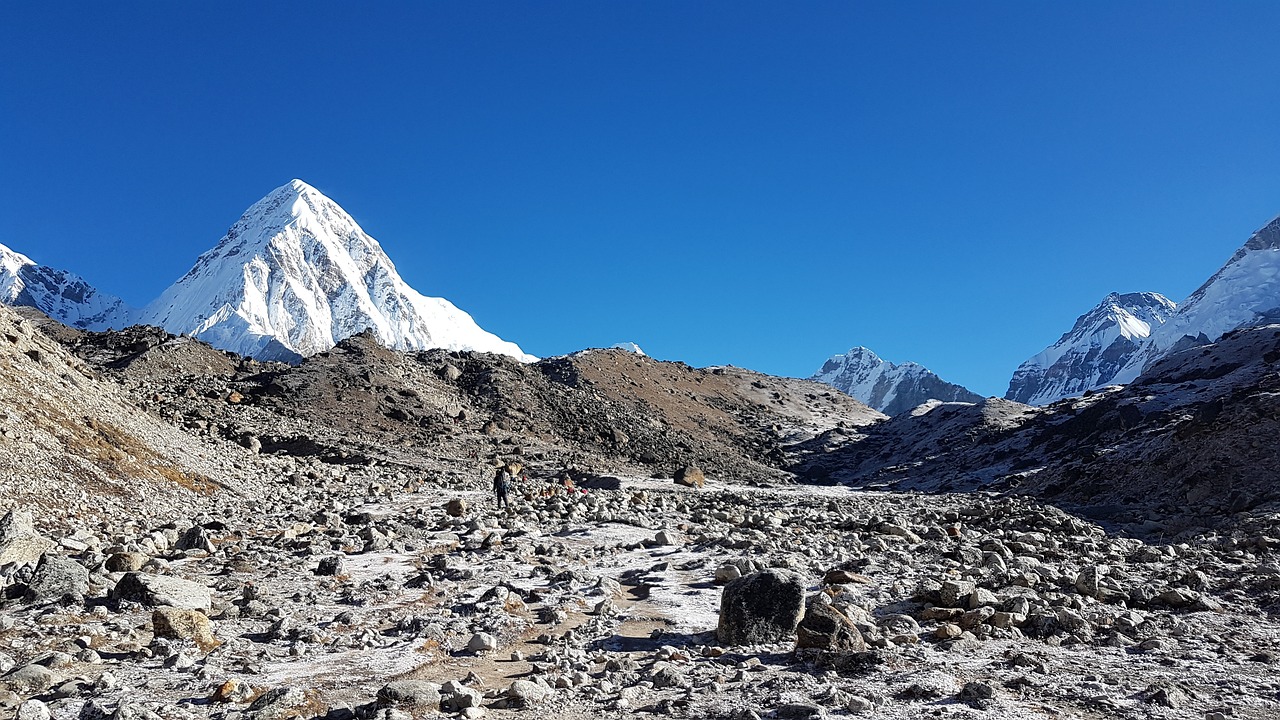
We begin the journey from Dingboche towards the small settlement of Lobuche today. The hike takes you to pastures and pastures to lush woods and to Lobuche which is a small settlement near the foot of the Lobuche peaks. Along the journey, you can also get good views of peaks like the Lingtern, the Pumori and the Khumbutse Himalayan peak. There is Trekkers Aid Post- situated at Pheriche (4210m). It is run by the Western Volunteer Doctors and assisted by The Himalayan Rescue Association. The aid post helps in the treatment of trekkers.
Overnight stay at the guesthouse. Breakfast, lunch and dinner included.
16
Day 16: Trek to Everest Base Camp. Overnight in Gorakshep. 7-8 hours
Today is one of the most anticipated days of the trek. From Lobuche, you will make your way towards Gorekshep (the last settlement) before the Everest Base Camp. From Gorekshep, you will finally hike along the Khumbu glacier moraine towards the base camp. There is not much elevation gain, but there are a lot of ups and downs and, combined with altitude, this can be a tiring portion- but the journey is worthy. From the base camp, you can see the glacier as well as the Khumbu Ice Fall. This is the point from where the Everest expedition begins. After spending some time at the base camp of Everest, you will return back to Gorekshep.
Overnight stay at the guesthouse. Breakfast, lunch and dinner included.
17
Day 17: Morning climb to Kala Patthar Everest viewpoint. Afternoon trek down to Pheriche. 6-7 hrs
The hike, from Gorekshep to Kalapatthar, will be started early in the morning. Kalapatthar is one of the best vantage points in the region. It presents panoramic views of the entire Mount Everest massif, Nuptse, Chagatse, Lhotse and the Pumori among many other peaks.You can catch the view of the sunrise amidst the Everest peaks from here. The phenomenon is quite ethereal. After viewing the breath-taking view of the Everest peak, you will have a hike back down to Gorekshep for hot and fresh breakfast and then descend to Pheriche.
Overnight stay at the guesthouse. Breakfast, lunch and dinner included.
18
Day 18: Trek to Namche Bazaar. 6-7 hours.
We return back to Namche from Pheriche. You will follow the Imja River to Tengboche, from there the trail then reaches to Phungki Thanka. Passing the Kyangjuma, you will finally reach Namche. The descent is easier than the ascent and you can trek though the woodlands and admire the mountain views along the journey. It is also a relaxing hike back and the sight of the landscape and the Himalayas can be enjoyed pleasantly.
Overnight stay at the guesthouse. Breakfast, Lunch and Dinner included.
19
Day 19: Trek down to Lukla. 7-8 hours
You will head back to Lukla from Namche as done before. It is ornamented with prayer flags, Chortens, Mani walls and Gompas. The gushing of the Dudh Koshi River will once again ring while you cross it via suspension bridges. After gradual ascending from Cheplung, you’ll reach Lukla for the night to stay at.
Overnight stay at the guesthouse. Breakfast, lunch and dinner included.
20
Day 20: Fly from Lukla to Kathmandu. 35-40 minutes.
Today, you will have a short flight from Lukla back to Kathmandu.It takes nearly half an hourto reach Kathmandu. You can see the peaks once again for the last time before you land at the bustling city. You will be taken to your hotel from the airport.
Overnight stay at the Hotel. Breakfast included.
21
Day 21: Transfer to International Airport for your onward destination.
Approximately three hours before your scheduled flight, you will be dropped off at the airport for your departure.
Breakfast included.

 17 Days / 16 Night
 Max People : 1
 Everest Base Camp, Khumbu region